
Blog | News | Insights

Latest updates, student visa news, education guides, and expert insights for international students.

What Does Level 3 Mean in Australian Immigration for Nepali Students?
Understanding Australia’s Risk Level System & How Nepali Students Can Still Get Visa Approval
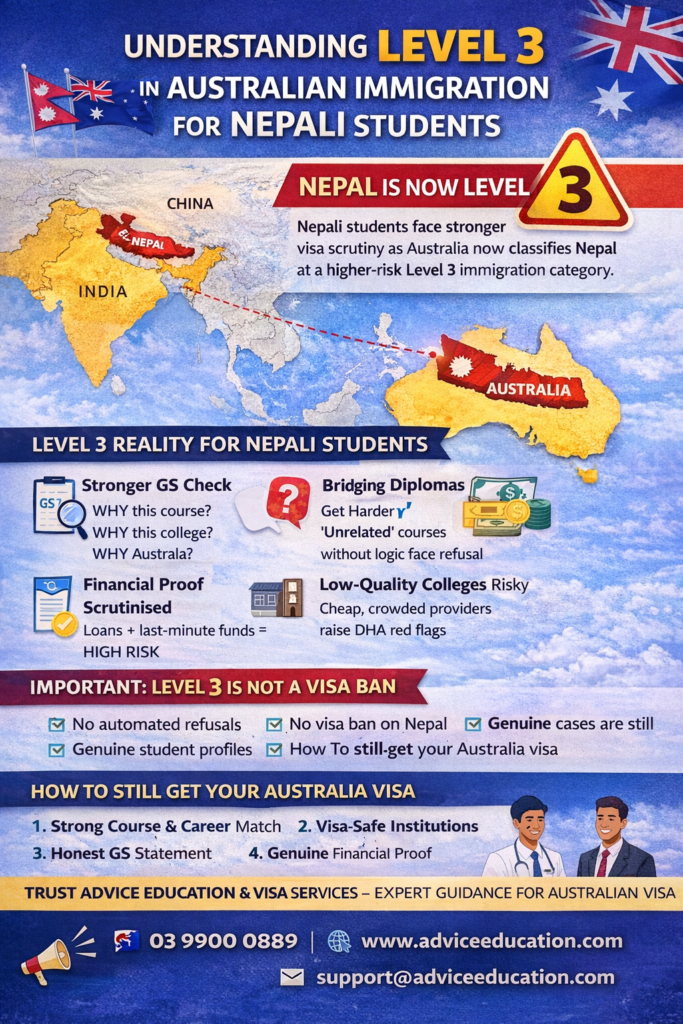
unverstanding level 3 in Austrlaialn immigration

Many Nepali students are hearing statements like:

“Australia visa is finished.”
“Nepal is Level 3, no chance now.”

This is misleading and incorrect.

Yes, Nepal is now treated as a higher-risk country (Level 3) under Australia’s student visa risk assessment.
But Level 3 does NOT mean Australia is closed for Nepali students.

It means Australia has become stricter, and only genuine, well-prepared students are being approved.


What Is “Level 3” in Australian Immigration?

Australia assesses student visa risk based on country profile and provider profile.
Level 3 indicates a higher immigration risk category.

For Nepali students, Level 3 means:

  • Closer scrutiny of applications

  • Stronger focus on Genuine Student (GS) criteria

  • Less tolerance for weak profiles or poor course logic

❌ It does not mean:

  • Visa ban

  • Automatic refusal

  • No approvals


Why Did Nepal Move to Level 3?

Nepal moved to Level 3 mainly due to:

  • High refusal rates from poorly prepared applications

  • Students choosing unrelated courses

  • Fake or borrowed financial evidence

  • “PR-only” intentions shown in GS statements

  • Overuse of low-level or non-genuine study pathways

👉 The issue is not Nepali students, but wrong advice and weak applications.


How Level 3 Affects Nepali Student Visa Applications

1️⃣ Stronger GS (Genuine Student) Assessment

The Department now checks:

  • Why this course?

  • Why this institution?

  • Why Australia?

  • Why now?

  • Why not Nepal?

Any mismatch = refusal risk.


2️⃣ Course Relevance Is Critical

Applications fail when:

  • Bachelor → Diploma downgrade without logic

  • Science background → hospitality/business with no explanation

  • Long academic gaps with no justification


3️⃣ Financial Evidence Must Be Genuine

Level 3 means:

  • Borrowed or last-minute funds are risky

  • Source of funds must be clear and lawful

  • Financial story must match family income


4️⃣ Provider Choice Matters More Than Ever

Choosing the wrong college increases risk:

  • Overcrowded low-level colleges

  • No academic progression

  • Poor completion history


Common Mistakes Causing Refusals (Level 3 Reality)

❌ Copy-paste GS statements
❌ “PR only” mindset
❌ Choosing cheapest course without logic
❌ Hiding study gaps
❌ Fake or inconsistent documents

Under Level 3, these mistakes are almost guaranteed refusals.


How Nepali Students Can Still Get Australia Visa (VERY IMPORTANT)

1. Strong Course & Career Alignment

Your course must:

  • Match your previous study or work

  • Show progression (not downgrade)

  • Lead to a realistic career outcome


2. Honest & Logical GS Statement

A strong GS explains:

  • Your background clearly

  • Why this course makes sense

  • Why Australia fits your plan

  • Why you will return or follow lawful pathways

No exaggeration. No PR obsession.


3. Choose Visa-Safe Institutions

Level 3 students should prioritise:

  • University or pathway-linked colleges

  • Institutions with clear progression

  • Regional or semi-regional options (when suitable)


4. Clean Financial Story

  • Funds shown early and consistently

  • Income source clearly explained

  • Expenses realistic and affordable


5. Professional Guidance (Not Sales Advice)

Most refusals happen due to:

  • Wrong counsellor advice

  • “Any college is fine” mentality

  • Visa handled like paperwork, not assessment


Is Australia Still Granting Visas to Nepali Students?

Yes — daily.

But approvals now go to students who are:

  • Academically genuine

  • Financially prepared

  • Career-focused

  • Properly guided

Australia is filtering out shortcuts, not genuine students.


How Advice Education & Visa Services Solves the Level 3 Gap

At Advice Education & Visa Services, we don’t sell dreams — we build visa-safe pathways.

We help Nepali students by:

  • Matching course with career, not commission

  • Writing strong, honest GS statements

  • Selecting Level 3-appropriate institutions

  • Preparing compliant financial documentation

  • Reducing refusal risk with strategy, not shortcuts

Problem is not Nepal.
Problem is wrong advice.


Final Message for Nepali Students

Level 3 is not the end.
It is a reset.

If your profile is genuine and your application is prepared correctly, Australia is still open for you.

FAQ

What does Level 3 mean for Nepali students applying for an Australian student visa?

Level 3 means that student visa applications from Nepal are assessed under higher scrutiny by Australian immigration. It does not mean a visa ban. Applicants must demonstrate stronger Genuine Student (GS) evidence, clear course progression, and credible financial documentation.

Does Level 3 mean Australia has stopped granting visas to Nepali students?

No. Level 3 does not mean Australia has stopped granting student visas. Visas are still being approved for Nepali students who submit genuine, well-prepared applications that meet all requirements.

Why are Nepali student visa refusals increasing under Level 3?

Refusals have increased mainly due to poor course relevance, unclear study progression, weak or inconsistent financial evidence, unexplained study gaps, and GS statements that fail to demonstrate genuine study intent.

How can Nepali students improve visa success under Level 3?

Students can improve their chances by choosing a course aligned with their academic or work background, providing genuine and well-documented finances, clearly explaining any study gaps, selecting reputable institutions with logical progression, and submitting a strong, honest GS statement.

What financial documents are important for Level 3 student visa applications?Applicants must provide clear evidence of funds for tuition and living costs, along with a transparent source of funds such as income, savings, education loans, or business income. Documents should be consistent, genuine, and verifiable.

Does choosing a low-cost college increase visa risk for Level 3 applicants?

Choosing a college only because it is low cost can increase visa risk if the course does not match the student’s background or lacks academic progression. A visa-safe choice focuses on course relevance and long-term education outcomes, not just fees.

Is a strong GS statement more important under Level 3?

Yes. Under Level 3, the GS statement is critical. It must clearly explain why the student chose the course, institution, and Australia, how the study supports their career plan, and why the applicant is a genuine student.

Can students with study gaps still get an Australian student visa under Level 3?Yes. Students with study gaps can still receive a visa if the gaps are properly explained with evidence such as work experience, training, health reasons, or family responsibilities, and the selected course shows logical progression.

How can Advice Education & Visa Services help Level 3 applicants from Nepal?Advice Education & Visa Services assists Nepali students by matching courses to individual profiles, planning visa-safe study pathways, reviewing financial documentation, preparing strong GS statements, and reducing refusal risks through honest and compliant guidance.
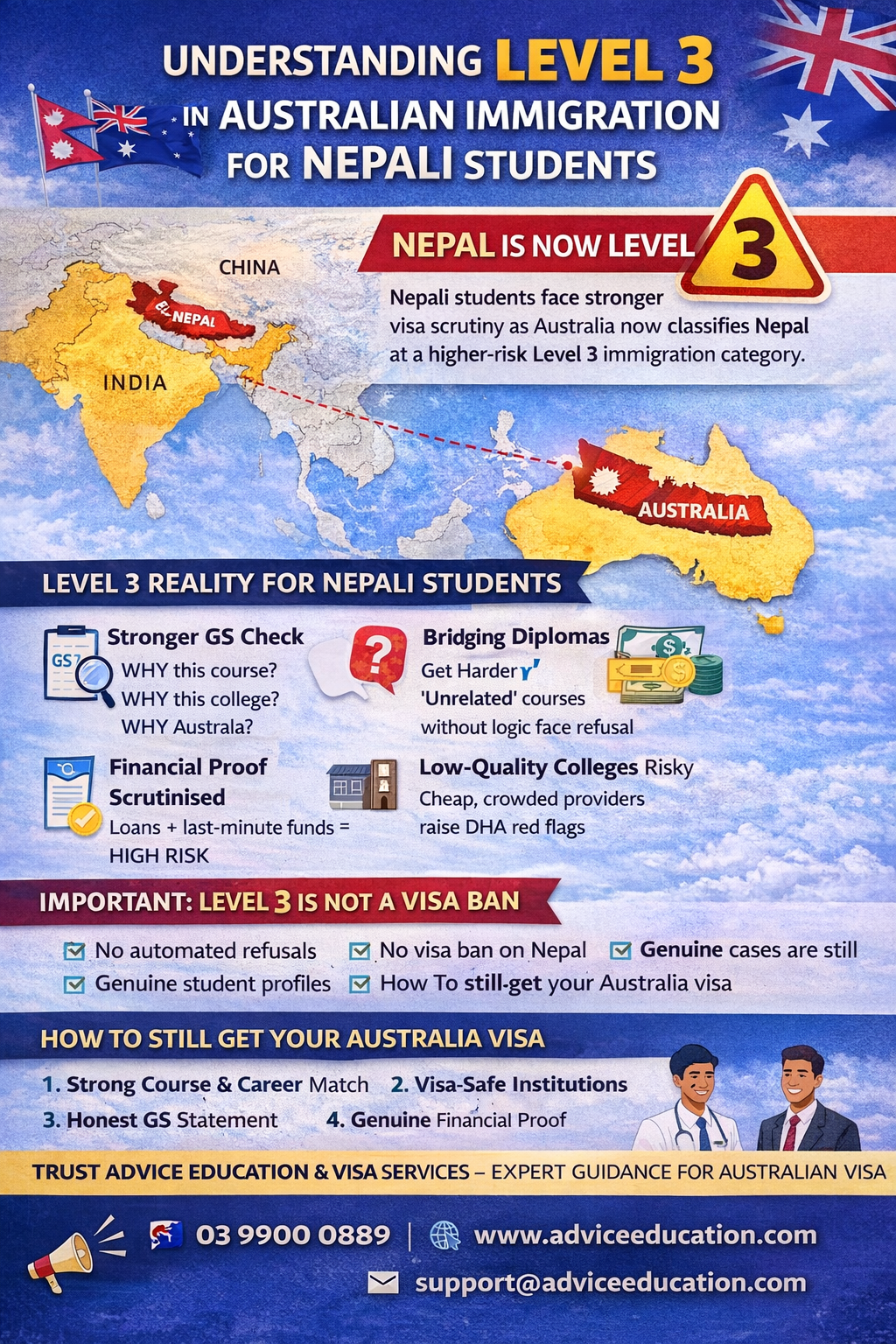
 

Australia Immigration Level 3 Explained for Nepali Students | Student Visa Guide

What Does Level 3 Mean in Australian Immigration for Nepali Students?
Understanding Australia’s Risk Level System & How Nepali Students Can Still Get Visa Approval

unverstanding level 3 in Austrlaialn immigration

Many Nepali students are hearing statements like:

“Australia visa is finished.”
“Nepal is Level 3, no chance now.”

This is misleading and incorrect.

Yes, Nepal is now treated as a higher-risk country (Level 3) under Australia’s student visa risk assessment.
But Level 3 does NOT mean Australia is closed for Nepali students.

It means Australia has become stricter, and only genuine, well-prepared students are being approved.


What Is “Level 3” in Australian Immigration?

Australia assesses student visa risk based on country profile and provider profile.
Level 3 indicates a higher immigration risk category.

For Nepali students, Level 3 means:

  • Closer scrutiny of applications

  • Stronger focus on Genuine Student (GS) criteria

  • Less tolerance for weak profiles or poor course logic

❌ It does not mean:

  • Visa ban

  • Automatic refusal

  • No approvals


Why Did Nepal Move to Level 3?

Nepal moved to Level 3 mainly due to:

  • High refusal rates from poorly prepared applications

  • Students choosing unrelated courses

  • Fake or borrowed financial evidence

  • “PR-only” intentions shown in GS statements

  • Overuse of low-level or non-genuine study pathways

👉 The issue is not Nepali students, but wrong advice and weak applications.


How Level 3 Affects Nepali Student Visa Applications

1️⃣ Stronger GS (Genuine Student) Assessment

The Department now checks:

  • Why this course?

  • Why this institution?

  • Why Australia?

  • Why now?

  • Why not Nepal?

Any mismatch = refusal risk.


2️⃣ Course Relevance Is Critical

Applications fail when:

  • Bachelor → Diploma downgrade without logic

  • Science background → hospitality/business with no explanation

  • Long academic gaps with no justification


3️⃣ Financial Evidence Must Be Genuine

Level 3 means:

  • Borrowed or last-minute funds are risky

  • Source of funds must be clear and lawful

  • Financial story must match family income


4️⃣ Provider Choice Matters More Than Ever

Choosing the wrong college increases risk:

  • Overcrowded low-level colleges

  • No academic progression

  • Poor completion history


Common Mistakes Causing Refusals (Level 3 Reality)

❌ Copy-paste GS statements
❌ “PR only” mindset
❌ Choosing cheapest course without logic
❌ Hiding study gaps
❌ Fake or inconsistent documents

Under Level 3, these mistakes are almost guaranteed refusals.


How Nepali Students Can Still Get Australia Visa (VERY IMPORTANT)

1. Strong Course & Career Alignment

Your course must:

  • Match your previous study or work

  • Show progression (not downgrade)

  • Lead to a realistic career outcome


2. Honest & Logical GS Statement

A strong GS explains:

  • Your background clearly

  • Why this course makes sense

  • Why Australia fits your plan

  • Why you will return or follow lawful pathways

No exaggeration. No PR obsession.


3. Choose Visa-Safe Institutions

Level 3 students should prioritise:

  • University or pathway-linked colleges

  • Institutions with clear progression

  • Regional or semi-regional options (when suitable)


4. Clean Financial Story

  • Funds shown early and consistently

  • Income source clearly explained

  • Expenses realistic and affordable


5. Professional Guidance (Not Sales Advice)

Most refusals happen due to:

  • Wrong counsellor advice

  • “Any college is fine” mentality

  • Visa handled like paperwork, not assessment


Is Australia Still Granting Visas to Nepali Students?

Yes — daily.

But approvals now go to students who are:

  • Academically genuine

  • Financially prepared

  • Career-focused

  • Properly guided

Australia is filtering out shortcuts, not genuine students.


How Advice Education & Visa Services Solves the Level 3 Gap

At Advice Education & Visa Services, we don’t sell dreams — we build visa-safe pathways.

We help Nepali students by:

  • Matching course with career, not commission

  • Writing strong, honest GS statements

  • Selecting Level 3-appropriate institutions

  • Preparing compliant financial documentation

  • Reducing refusal risk with strategy, not shortcuts

Problem is not Nepal.
Problem is wrong advice.


Final Message for Nepali Students

Level 3 is not the end.
It is a reset.

If your profile is genuine and your application is prepared correctly, Australia is still open for you.

FAQ

What does Level 3 mean for Nepali students applying for an Australian student visa?

Level 3 means that student visa applications from Nepal are assessed under higher scrutiny by Australian immigration. It does not mean a visa ban. Applicants must demonstrate stronger Genuine Student (GS) evidence, clear course progression, and credible financial documentation.

Does Level 3 mean Australia has stopped granting visas to Nepali students?

No. Level 3 does not mean Australia has stopped granting student visas. Visas are still being approved for Nepali students who submit genuine, well-prepared applications that meet all requirements.

Why are Nepali student visa refusals increasing under Level 3?

Refusals have increased mainly due to poor course relevance, unclear study progression, weak or inconsistent financial evidence, unexplained study gaps, and GS statements that fail to demonstrate genuine study intent.

How can Nepali students improve visa success under Level 3?

Students can improve their chances by choosing a course aligned with their academic or work background, providing genuine and well-documented finances, clearly explaining any study gaps, selecting reputable institutions with logical progression, and submitting a strong, honest GS statement.

What financial documents are important for Level 3 student visa applications?Applicants must provide clear evidence of funds for tuition and living costs, along with a transparent source of funds such as income, savings, education loans, or business income. Documents should be consistent, genuine, and verifiable.

Does choosing a low-cost college increase visa risk for Level 3 applicants?

Choosing a college only because it is low cost can increase visa risk if the course does not match the student’s background or lacks academic progression. A visa-safe choice focuses on course relevance and long-term education outcomes, not just fees.

Is a strong GS statement more important under Level 3?

Yes. Under Level 3, the GS statement is critical. It must clearly explain why the student chose the course, institution, and Australia, how the study supports their career plan, and why the applicant is a genuine student.

Can students with study gaps still get an Australian student visa under Level 3?Yes. Students with study gaps can still receive a visa if the gaps are properly explained with evidence such as work experience, training, health reasons, or family responsibilities, and the selected course shows logical progression.

How can Advice Education & Visa Services help Level 3 applicants from Nepal?Advice Education & Visa Services assists Nepali students by matching courses to individual profiles, planning visa-safe study pathways, reviewing financial documentation, preparing strong GS statements, and reducing refusal risks through honest and compliant guidance.


Share the Post:

Related Posts